

Condominium Fire Safety
By Gary Porter, FMP, RS, RRC, CPA
When the Palisades and Eaton Fires tore through Los Angeles County in January 2025, they destroyed more than 16,000 structures and claimed 29 lives. Within 48 hours of ignition, these fires became the second and third most destructive wildfires in California's history. For condominium communities—where buildings are inherently close together and shared responsibility defines property management—these fires offer critical lessons that cannot be ignored.
The Insurance Institute for Business & Home Safety (IBHS) recently released its comprehensive report on these conflagrations, and the findings should concern every board member, property manager, and homeowner in fire-prone regions. While California's climate creates ideal wildfire conditions through prolonged drought, dry vegetation, high temperatures, and strong winds, the research reveals that how we build, maintain, and manage our communities plays an equally important role in determining survival.
Understanding the Perfect Storm
January is not typically wildfire season in Southern California. Winter months usually bring rainfall that increases fuel moisture and reduces fire risk. But 2025 was different. A flash drought that began in December created tinder-dry conditions. When strong Santa Ana winds arrived in early January—with gusts reaching 100 mph in some areas—dozens of ignitions occurred across the region.
What made the Palisades and Eaton Fires so devastating wasn't just the weather. These fires ignited near densely built suburban communities where structures sat close together, often separated by less than 10 feet. Once fire entered these neighborhoods, it spread from building to building in what experts call "conflagration"—uncontrolled structure-to-structure fire spread that overwhelms firefighting resources.
The IBHS investigation, conducted in partnership with CAL FIRE just days after the fires, examined 252 properties in detail, collecting more than 60 data points at each location. Combined with CAL FIRE's damage inspection data covering more than 30,000 structures, the research provides unprecedented insight into what protects buildings during extreme wildfire events—and what doesn't.
The Three Pillars of Fire Survival
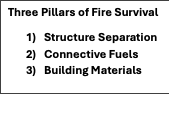
The investigation identified three primary factors that determine whether a structure survives a wildfire: structure separation, connective fuels, and building materials. For condominium communities, understanding how these factors interact is essential because traditional single-family mitigation strategies often don't translate directly to multi-unit properties.
Structure Separation: The Distance That Matters
In single-family neighborhoods, homeowners have some control over landscaping and fuel management, but they cannot move their neighbor's house. Condominium communities face an even greater challenge: buildings are designed to be close together, often sharing walls or separated by minimal distances.
The IBHS research quantified just how critical this spacing is. For every additional 10 feet of separation between structures, the likelihood of damage decreased by 7-13%, up to a distance of 30 feet. Beyond 30 feet, the benefit of additional spacing leveled off.
More striking was the role of wind direction. For the first time, researchers systematically analyzed how wind affects fire exposure between adjacent buildings. In the Palisades Fire, structures downwind from a burning building were 22% more likely to be damaged or destroyed than those in crosswind or upwind positions—regardless of building materials or defensive space efforts.
At separations less than 10 feet—common in many condominium developments—even homes with four wildfire-resistant building features had less than a 50% chance of avoiding damage. The intense heat from a burning adjacent structure simply overwhelmed protective measures.
For condominium associations, this reality means that when structure density cannot be changed, the other two pillars—connective fuels and building materials—become absolutely critical.
Connective Fuels: The Hidden Pathways
Connective fuels are combustible materials that create pathways for fire to spread from one ignition source to a structure. In the LA fires, nearly every property surveyed had combustible materials within five feet of the building—a zone California now recognizes as "Zone 0," where ember-resistant landscaping is essential.
The impact of these fuels was dramatic. When both Zone 0 (0-5 feet) and Zone 1 (5-30 feet) had up to 25% combustible fuel coverage, structures faced a 58% chance of being damaged or destroyed. When Zone 0 fuel coverage exceeded 25%, that likelihood jumped to 87-100%.
What surprised investigators was the variety of everyday items that served as connective fuels. Trash bins positioned against buildings, combustible deck furniture, hot tubs adjacent to windows, decorative pergolas near doors—all became fuel for the fire once ignited by embers. In one documented case, a hot tub with surrounding deck and vegetation generated enough heat to fail double-pane tempered windows in a structure with noncombustible siding.
Fences presented a particularly insidious problem. While combustible wood fences are recognized fire hazards, investigators repeatedly found vegetation growing along noncombustible fences, negating their protective value. Fire used these vegetated fence lines as highways through neighborhoods, probing one fuel pathway after another until finding a vulnerability.
For condominium communities, these findings have direct implications. Common area landscaping, shared fences, recreational amenities like pools and spas, waste management areas, and outdoor furniture all require careful evaluation and management to reduce fire pathways.
Building Materials: The System, Not the Sum
Most structures surveyed after the fires included at least one wildfire-resilient feature—typically noncombustible exterior siding or a Class A-rated roof. However, few buildings incorporated a comprehensive system of resilient components. This left openings for flames, radiant heat, and embers to exploit.
The data was clear: structures with four wildfire-hardening characteristics had a 54% likelihood of experiencing no damage under severe conflagration conditions, regardless of separation distance. In contrast, structures with only one or two hardening features had just a 36% chance of avoiding damage.
The most common resilient features observed were noncombustible exterior wall cladding (stucco, brick, concrete) and Class A roof coverings (asphalt shingles, tile). Yet these were frequently paired with vulnerable components:
Windows were often the first components to fail. Single-pane or double-pane windows with annealed glass cracked under heat exposure. Vinyl window frames softened and failed, causing glass panes to fall out and creating openings for embers and flames. Metal-framed windows with tempered or multi-pane glass performed significantly better.
Doors showed consistent vulnerabilities, particularly at thresholds and jambs where embers accumulated. Combustible doors ignited from the bottom up, with flames spreading vertically along the frame. In several cases, doors completely detached from structures, opening the building envelope to fire entry.
Vents represented one of the most widespread weaknesses. Across nearly all surveyed structures, vents either lacked mesh screens entirely or had mesh openings larger than the recommended 1/8 inch. This allowed embers to enter attic spaces and other concealed areas, causing internal ignitions that were difficult for firefighters to detect and extinguish.
Eaves—the underside of roof overhangs—were frequently open rather than enclosed, providing direct pathways for flames to reach roof assemblies and attic spaces.
The research demonstrated that buildings function as integrated systems. A structure might have noncombustible siding and a Class A roof, but if windows fail, vents allow ember entry, and eaves provide flame pathways, the building remains highly vulnerable.
Practical Steps for Condominium Communities
Given the inherent density of condominium properties, what can associations realistically do to improve fire resilience? The IBHS findings point to clear priorities:
Immediate Actions:
- Audit all vents on buildings and replace screens with 1/8-inch corrosion-resistant metal mesh or install vents tested to ASTM E2886 standards for ember resistance.
- Clear Zone 0 ruthlessly. Remove all combustible materials—mulch, plants, decorative features, furniture, trash enclosures—within five feet of all buildings. Replace with noncombustible hardscaping, gravel, or pavers.
- Assess Zone 1 fuels (5-30 feet from buildings). Reduce vegetation density, particularly shrubs and ornamental trees. Create separation between plant groupings. Keep fuel coverage below 25%.
- Secure or relocate outdoor amenities. Move trash enclosures, recycling bins, and outdoor furniture away from buildings. If hot tubs or spas are adjacent to structures, ensure they're not near windows or doors and have noncombustible surrounds.
- Maintain defensible space continuously. Debris removal from roofs, gutters, decks, and landscape areas must be ongoing, not seasonal. Dead vegetation, fallen leaves, and pine needles create ember ignition points.
Medium-Term Improvements:
- Evaluate window systems during replacement cycles. Prioritize multi-pane windows with at least one tempered pane and noncombustible frames (metal or fiberglass, not vinyl). Consider the fire rating of glass used.
- Upgrade exterior doors to models with fire-resistance ratings of at least 20 minutes when tested to NFPA 252 standards. Ensure weather-stripping and thresholds don't create ember accumulation points.
- Inspect fire doors in high-rise buildings regularly. These doors prevent fire spread between floors and must operate properly. Failed closers, damaged seals, or blocked doors compromise building protection.
- Address eaves and overhangs. When buildings undergo exterior renovations, enclose open eaves with noncombustible materials rated for fire exposure.
- Review fence maintenance policies. If fences are combustible, establish vegetation-free zones along fence lines. Consider noncombustible fence materials during replacement, but recognize that even metal fences can support combustible vegetation if not maintained.
Long-Term Planning:
- Prioritize fire ratings in capital planning. When budgeting for roof replacement, siding repairs, or window upgrades, factor in the fire-resistance rating of materials. The incremental cost of higher-rated products is often modest but the protection value is substantial.
- Create a comprehensive fire mitigation plan that addresses all three pillars: managing what's between buildings (connective fuels), hardening building exteriors (materials), and recognizing the fixed challenge of building proximity (separation).
- Coordinate with neighboring properties. Fire doesn't respect property lines. If your association's mitigation efforts are undermined by an adjacent property's combustible landscaping or poor maintenance, work collaboratively to address shared risks.
The Systems Approach
Perhaps the most important lesson from the 2025 LA fires is that piecemeal mitigation doesn't work. Fire probes every weakness, testing one pathway after another until it finds vulnerability. A building with excellent siding and roofing but poor windows will fail. A property with a perfect Zone 0 but dense vegetation in Zone 1 remains at risk. A community that hardens buildings but allows trash bins and furniture against walls creates ignition points.
When the IBHS researchers examined undamaged structures in heavily burned neighborhoods, they found that survival was rarely due to a single factor. Instead, these buildings benefited from multiple protective measures working together: adequate separation where possible, minimal connective fuels, and integrated building hardening.
For condominium communities, this systems perspective is both challenging and empowering. The challenge lies in coordinating improvements across multiple buildings, balancing aesthetics with safety, and securing funding for upgrades. The empowerment comes from recognizing that associations have control over many of these factors through maintenance standards, landscape policies, architectural guidelines, and capital planning.
Moving Forward
The Palisades and Eaton Fires join a growing list of conflagrations—Paradise, California in 2018, Lahaina, Hawaii in 2023—that demonstrate how quickly fire can consume suburban communities under extreme conditions. While we cannot eliminate wildfire risk in fire-prone regions, we can significantly improve community resilience through informed, systematic mitigation.
For condominium associations, the time to act is before the next fire season. Review your property with fresh eyes, looking for the connective fuels that create fire pathways. Audit your buildings for the vulnerable components that repeatedly failed in LA County. Develop a multi-year plan to strengthen your community's defenses systematically, not sporadically.
The IBHS research provides a roadmap. The question is whether communities will follow it before the next conflagration puts that knowledge to the test.
As a reserve professional my focus is on building materials, the items that show up in the reserve study. When associations replace doors and windows we recommend upgrading to fire rated materials. These are often at higher costs than simply replacing with “like kind” products which is the standard applied by most associations. Balancing cost and safety are difficult decisions but having knowledge and considering risks provide guidance. We also routinely recommend checking and replacing vents which is an item not normally included in reserve studies.
Gary Porter, FMP, RS, RRC, CPA is the CEO of Facilities Advisors International and has prepared reserve studies for associations since 1982. As a Facilities Management Professional (FMP) he has training in all phases of facilities management. As a CPA he also focuses on the numbers. Gary is a past president of CAI (1998) and was a founding member of the CAI California Channel Islands Chapter in 1979. 47 years as a CAI member. He resides in Las Vegas, NV. Facilities Advisors serves associations nationwide.